Quality of Life Grantee Spotlight: MetroHealth Rehabilitation Institute
Sexual health and intimacy are two of the most personal and often overlooked dimensions of life after a spinal cord injury. Resources can be hard to find, and there is often uncertainty about what is possible moving forward.
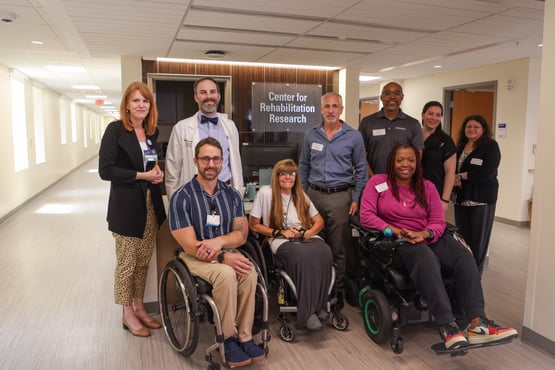
“It is a tough topic to discuss in a group setting,” says Gillian Gulan, an occupational therapist in the MetroHealth Rehabilitation Institute’s inpatient neurorehabilitation unit. “People fumble through the options because the topic can feel taboo. For many years, we weren’t adequately addressing the issue.”
Gulan made it a personal quest to find a way to make this challenge better. Several years ago, she partnered with occupational therapy students to develop more robust educational materials, but she wanted to do more.
“I needed a grant to develop an adaptive intimacy program,” says Gulan. “It is a sensitive topic, but it is also a quality-of-life issue.”
In 2024, MetroHealth received a $24,609 Christopher & Dana Reeve Foundation Quality of Life grant to create an Adaptive Intimacy Lab. The pioneering project retrofitted a room into a simulated bedroom to showcase technologies that enhance independence in physical intimacy, environmental control and home accessibility.
“We wanted to create a private place to talk with a significant other. A place that could break down obstacles and provide access to non-medical rehabilitation tools,” says Gulan. “By focusing on autonomy and dignity, we can redefine what comprehensive recovery truly means.”
Two community consultants living with paralysis helped guide the thoughtful design of the room. Furnished with a standard-height queen-size bed, a couch and an easy glider chair, the room also includes dozens of wedges, positioning tools and many other assistive technology devices to help individuals reclaim independence, confidence and connection.
“It is meant to be a comfortable space and an opportunity to try it before you buy it yourself,” says Gulan. “Participants are clothed, and a therapist helps guide the experience to see what works best for each individual.”
The room is open to both inpatient and outpatient participants. Therapists also address what intimacy means beyond physical interaction to include psychological aspects and safety issues related to spasms, pain and other challenges that may impact intimacy.
“The room is used for education, and everyone is coming into the conversation from a different background and space,” says Gulan. “People find it so freeing to be able to open up and talk about it. It has also started many conversations among the medical staff who feel more empowered to approach sensitive topics with positive language.”
As of February, 25 individuals living with paralysis, aged 17 to 86, and 20 of their partners have used the room since it opened in June 2025. A partnership has already formed with MetroHealth’s Comprehensive Sexual Health Center, and Gulan hopes the room can serve as a catalyst to inspire other health systems to address the issue.
“We are still getting the word out, and we know that participant number will only continue to grow,” says Gulan. “We’ve opened a Pandora’s box of sexual health issues. We are so grateful to the Reeve Foundation for helping MetroHealth lead the way in this area.”
Located in Cleveland, Ohio, MetroHealth Rehabilitation Institute is part of The MetroHealth System and is one of 18 federally designated Spinal Cord Injury Model Systems in the U.S., recognized for its comprehensive coordinated care and research. In 2003, Christopher Reeve received care at MetroHealth following his spinal cord injury.
The MetroHealth Foundation, 501(c)(3) supporting organization for The MetroHealth System, has received two prior quality of life grants in 2010 and 2015 which supported technology purchases and modifications to the Zubizarreta House at MetroHealth, a fully-accessible home designed for individuals with paralysis, respectively. MetroHealth System clinicians have also worked collaboratively for many years with the Reeve Foundation.
“The grant is helping us transform patient care,” says Gulan. “I am humbled by this experience. It is amazing to think about how far the impact of this project can reach.”
Learn more about our Quality of Life Grants program by visiting here.
Join Our Movement
What started as an idea has become a national movement. With your support, we can influence policy and inspire lasting change.
Become an Advocate