How Disability Awareness and Rights Have Changed: 1950-2025
Most of us live in the moment, focused on our everyday lives. But the longer we live, the more our viewpoints evolve to include the past and future. In my case, ever since my spinal cord injury in 1965 at the age of 20, my viewpoint has expanded from 60 years of full-time wheelchair use. Now 80, I spend a lot of time remembering, analyzing, and writing about how life with paralysis has changed over the years.
1950-1975
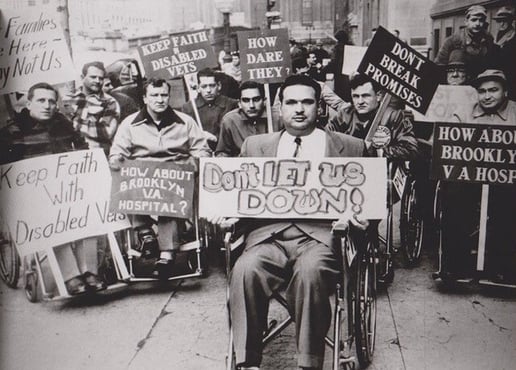
The post-WWII era was difficult and isolating for those of us with paralysis. In 1950, a movie starring a young Marlon Brando as a paraplegic veteran (“The Men”), accurately depicted daily life in one of the first rehab programs. Based on true events, a pioneering VA program gave newly paralyzed vets a chance to design and carry out their own rehab regimen. It focused primarily on physical exercise to build upper body strength with the purpose of culminating in release — overseen by an Army doctor — into mainstream culture.
At this time the stigma of “otherness” attached to paralysis — in the media as in real life — was so great that reintegration into the post-war world was traumatic for disabled vets. Brando’s character found that he could no longer connect with his wife, and his companions had problems with physical accessibility, independence, depression and feelings of alienation from loved ones — as well as estrangement from civilian life. In the movie, many vets with para- and quadriplegia, all men, chose to return to the rehab hospital. In the media as well as in real life, stories of women with paralysis were scarce at this time, and the unfortunate ones with quadriplegia were not expected to actively participate in daily life, assuming they even survived during the first year.
In 1965, when I was discharged from a hospital after four months of rehab, I returned to my small hometown and found no ramps, curb cuts, and very little accessibility. My boyhood home was only partially accessible. I could not participate in my college graduation ceremony since no one considered building a temporary ramp. Nor could I get a teaching credential or a teaching job since boards of education prohibited hiring teachers who used wheelchairs. Like the paralyzed vets in the movie of 15 years earlier, I gradually became alienated and despondent. I finally found my way, only two years removed from the recission of the last Ugly Law in Chicago that made appearing in public with a disability illegal, in 1975, when I returned to graduate school with a different plan.
1976-2000
This was a time of personal growth for me that coincided with the rise of the disability rights movement, thanks to Ed Roberts and the infamous “Rolling Quads,” who gained media attention as the first quads admitted to the University of California, Berkeley. They were true pioneers, pushing societal norms, the social code, and establishing their right to fairness in education and more, demanding that people with disabilities were owed the same dignity and rights as others, not pity or charity. Their actions, led by Roberts’ witty and incisive public pronouncements, began to be noticed.
At the same time, Judy Heumann, a polio survivor, was leading the fledgling disability rights movement from New York, after suing and winning the right to a public education in her state. In 1977, disability rights advocates from all over the nation participated in protests at state capitols, with about 100 occupying the federal Health, Education and Welfare building in San Francisco, demanding that HEW Secretary Joseph Califano sign the 1973 Vocational Rehabilitation Act, Section 504, which guaranteed education and health benefits to people living with disabilities.
The timing was perfect for me and countless others. I graduated with a master’s degree two months after the Act was signed, and in the fall of 1977, I was hired to teach at a community college in Portland, Oregon.
2001-2025
In 2000, after more than 20 years of combined teaching and organic farming, I became editor of New Mobility magazine. The 1973 Rehab Act had led to more disability advocacy and passage of the 1990 Americans with Disabilities Act, forming the foundation of disability rights. From 2000 until the present day, many breakthroughs and improvements have made it possible for those of us with paralysis to have a chance at living a fulfilling life, but not without resistance. Just as with other groups, our hard-earned rights have been challenged and opposed.
Today, the supports we have earned are being challenged, and we can take nothing for granted. Our right to reasonable accommodations in education, healthcare and employment must not be weakened or abandoned. The principles behind these improvements between the early days of my injury and today must be safeguarded.
Now is the time to support the nonprofit organizations that support us in our long journey to a fairer world and a level playing field. Never before has disability advocacy been so important. We must hold strong to what disability pioneers like Ed Roberts and Judy Heumann fought for, and we must do it together, now.
To learn more and get more involved with advocacy, check out ChristopherReeve.org/Advocacy.
Join Our Movement
What started as an idea has become a national movement. With your support, we can influence policy and inspire lasting change.
Become an Advocate